How Long Does Teeth Whitening Last? A Realistic Timeline

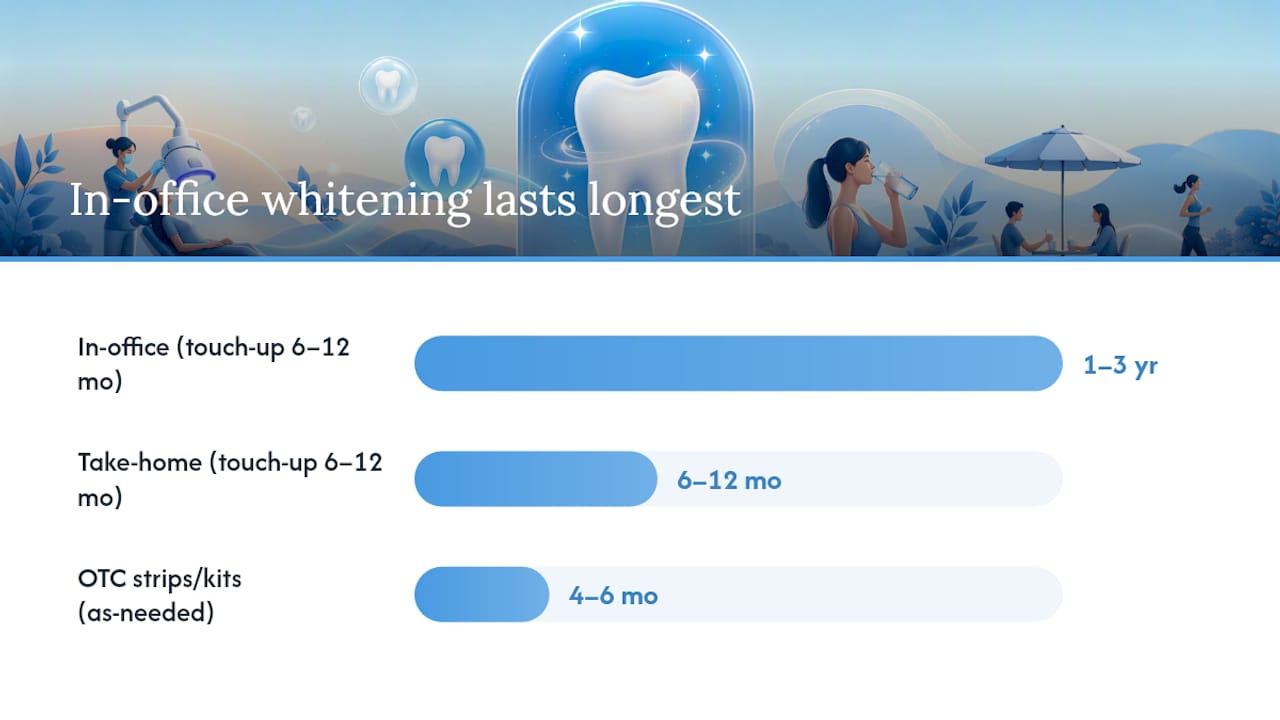
Teeth whitening isn’t permanent, but it isn’t fleeting either. In-office whitening typically lasts one to three years, dentist-supplied take-home trays hold up for six to twelve months, and over-the-counter strips or kits usually fade in four to six months. The gap comes down to bleaching strength, contact time, and how well you protect your results afterward.
In-office bleaching: Highest concentration, fastest results, longest-lasting under professional supervision.
Dentist take-home trays: Moderate strength, custom fit, dependable middle ground.
OTC strips/toothpaste: Lowest concentration, shortest-lived, minimal supervision.
The ADA and NHS both confirm that professional options outperform store-bought products in strength and durability.
Key Takeaways
Teeth whitening results fade at different rates depending on method, habits, and stain type, and a dentist-guided maintenance plan extends them the longest.
Point | Details |
Duration varies by method | In-office lasts one to three years, take-home trays six to twelve months, OTC kits four to six months. |
Stain type changes the timeline | Extrinsic stains respond faster; intrinsic stains like tetracycline discoloration can need months of nightly treatment. |
Habits drive re-staining speed | Coffee, tea, red wine, and tobacco shorten results faster than any other factor you control. |
Sensitivity is usually temporary | Mild sensitivity or gum irritation typically resolves within days to two weeks when treatment is properly spaced. |
Mersaldental offers both paths | In-office whitening and dentist-supplied take-home trays are available with direct insurance billing and CDCP acceptance. |
Table of Contents
In-Office vs. Take-Home vs. OTC: Which Whitening Lasts Longest?
Every whitening method bleaches the same way, but the concentration and supervision behind it change everything about how long the results stick around.
Method | Typical duration | Speed of results | Cost range | Sensitivity risk | Professional supervision needed |
In-office whitening | one to three years | Immediate, single visit | Higher, one-time fee | Moderate, short-term | Yes, dentist-administered |
Dentist take-home trays | six to twelve months | Gradual, — | Mid-range | Low to moderate | Yes, custom trays and monitoring |
OTC strips/toothpaste | four to six months | Slow, weeks to months | Lowest | Variable, less controlled | No, self-directed |
Want a fast, dramatic change before an event? In-office whitening delivers it in a single appointment, per Tufts Now.
Want a reliable middle ground you can repeat at home? Take-home trays fitted by a dentist balance cost and control.
Just testing the waters? OTC kits are the cheapest entry point but fade fastest and offer the least predictability.
Faster results don’t automatically mean longer-lasting ones. A single in-office session works because of the concentration, not because the effect is somehow “locked in.” Without maintenance, even the strongest treatment fades on the same biological clock as a weaker one, just slower.
How Does Teeth Whitening Actually Work?
Whitening agents, usually hydrogen peroxide or carbamide peroxide, break down and release oxygen molecules that penetrate enamel and dentin to break apart the compounds causing discoloration, called chromophores. Carbamide peroxide breaks down more slowly, which is why it’s the standard choice for at-home trays where a lower, steadier dose works overnight.
Not all stains respond the same way:
Extrinsic stains (coffee, tea, red wine, tobacco) sit on the enamel surface and usually respond well and quickly.
Intrinsic stains (from aging, trauma, or tetracycline exposure) sit deeper in the dentin and need longer, repeated treatment.
Some tetracycline-related stains require three to four months of nightly treatment before real improvement shows. That’s the concentration-versus-time trade-off in practice: strong and fast in the chair, or gentle and gradual at home.
What Makes Whitening Results Fade Faster or Slower?
Some habits speed up fading, others slow it down, and a few factors are simply out of your control.
Modifiable factors include coffee, tea, and red wine consumption, tobacco use, and how often you get professional cleanings. Nonmodifiable factors include intrinsic staining and existing restorations. Crowns, veneers, and fillings don’t respond to bleaching agents at all, so as your natural teeth whiten or later re-stain, restorations can look mismatched even when nothing has changed on them.
Pro Tip: Drink coffee, tea, or red wine through a straw when possible, and rinse your mouth with water right after. That five-second habit meaningfully cuts down the surface staining that shortens visible results.
How Often Should You Whiten to Keep Results?
Duration and touch-up frequency track closely with the method you chose, though your diet and habits shift the numbers in either direction.
Method | Typical duration | Suggested touch-up frequency |
In-office whitening | one to three years | Every six to twelve months, or as staining returns |
Dentist take-home trays | six to twelve months | Every six to twelve months |
OTC strips/kits | four to six months | As needed, following product directions with rest periods |
Dental practices generally recommend spacing professional sessions at least six to twelve months apart for safety, while OTC cycles need built-in breaks to avoid overuse. The right trigger for a touch-up isn’t a calendar date. It’s visible fading, returning stains, or a sensitivity pattern your dentist has already cleared as normal for you.
Are There Side Effects From Teeth Whitening?
Tooth sensitivity and mild gum irritation are the two most common side effects, and both are usually temporary, resolving within a few days to two weeks after treatment ends.
Overuse is the real risk factor. Repeated, aggressive bleaching, especially beyond what a dentist recommends, can cause persistent sensitivity or enamel erosion, not just short-term discomfort.
Reduce your risk by:
Getting a dentist assessment before starting, especially if you have existing sensitivity.
Using correctly fitted trays rather than one-size-fits-all versions.
Following exact contact-time directions. Leaving product on longer doesn’t whiten more; the active agent simply breaks down.
Stopping and calling your dentist if sensitivity is sharp, persistent, or paired with gum pain.
How Can You Maintain Whitening Results Longer?
Maintenance is where most people either protect their investment or waste it within a few months. A few daily habits and a periodic touch-up plan do most of the work.
Daily habits: Brush and floss consistently, use a desensitizing toothpaste if sensitivity shows up, and rinse after dark-colored foods or drinks. Hold off on your first post-whitening cleaning for a few days to let enamel stabilize.
Periodic maintenance: Plan on occasional touch-up nights with your trays, or a repeat strip cycle, based on how quickly staining returns for you specifically.
Pro Tip: Ask your hygienist to fold a whitening check into your regular cleaning appointment. It’s the easiest way to catch early re-staining before it becomes a full touch-up.
When Should You See a Dentist About Whitening?
See a dentist before you start, not after you’re disappointed with the results. A checkup rules out active decay, gum disease, or worn enamel that whitening could aggravate, and it flags restorations that won’t respond to bleach the way your natural teeth will.
Dentist-supplied trays let sensitive patients and complex stain cases get a plan built around their own enamel, not a generic timeline. A personalized, dentist-guided schedule consistently produces better long-term results than a one-size-fits-all approach.
A dentist’s-eye view on lasting whiter teeth
Whitening works best as a professional starting point followed by a maintained routine, not a single fix-it appointment. We see the biggest disappointments when patients treat whitening as permanent and skip the follow-up care that actually protects it. The combination of an initial professional treatment plus a realistic, dentist-guided maintenance plan is what delivers results people are still happy with a year later.
Ready to Brighten and Protect Your Smile?
Mersaldental offers both in-office whitening for fast, dentist-supervised results and take-home kits for steady maintenance between visits, so you’re never stuck choosing between speed and durability. Because we bill insurance directly and accept CDCP, professional whitening is often more accessible than patients expect compared to piecing together OTC products on your own.

If you’re ready to find out which option fits your enamel, stain type, and budget, book a whitening consultation with our downtown Ottawa team and get a plan built around your actual mouth, not a generic timeline.
Frequently Asked Questions
How long does teeth whitening last on average? Most people see results last four months to three years depending on the method used, with in-office treatments lasting longest and OTC kits fading fastest.
How often can you whiten your teeth safely? Professional whitening is generally spaced six to twelve months apart, while OTC products should follow package directions with built-in rest periods between cycles.
Is carbamide peroxide or hydrogen peroxide better for whitening? Hydrogen peroxide works faster and is common in-office, while carbamide peroxide breaks down more slowly, making it better suited to take-home trays.
Do teeth whitening results fade even if you’re careful? Yes. Whitening isn’t permanent, and natural remineralization plus daily food and drink exposure will gradually bring stains back regardless of how careful you are.
Can restorations like crowns or fillings be whitened? No. Crowns, bridges, and fillings don’t respond to bleaching agents, so they can look mismatched against newly whitened natural teeth over time.
This article is general information, not a substitute for advice from a qualified doctor. Consult a qualified healthcare professional about your own circumstances before acting on anything here.
Sources
Recommended
Comments